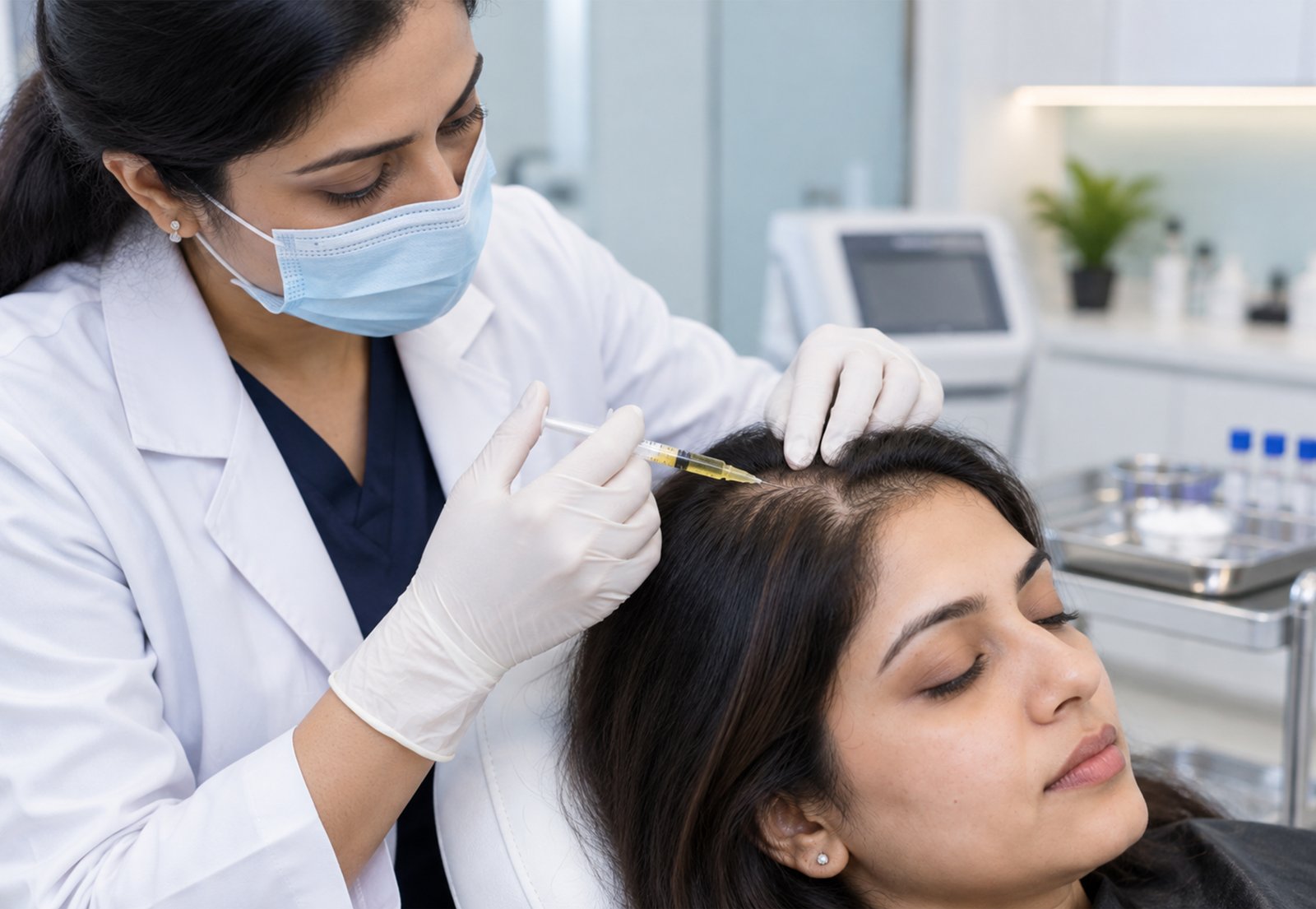
You may notice greater amounts of hair in your pillows, your shower drain, or even on your hairbrush than normal, which is a bit upsetting. It's one of the most common reasons that people look for treatments for falling hair in Rohini. Hair fall that is persistent can be due to various reasons, ranging from genetics and stress to hormonal imbalances and nutritional shifts. Consulting an expert dermatologist is the most reliable method to pinpoint the root of it and determine the best treatment method. This guide outlines the important questions to ask at your first appointment to ensure that you arrive prepared, rather than merely waiting for the appointment to cover everything you want it to.
Why You Should Visit a Dermatologist for Hair Fall?
The loss of hair is normal. The majority of people shed between 50 and 100 hairs each day as part of the natural cycle of growth. The point at which it gets to be considered a problem is when the rate of shedding increases and persists for months or even years with no improvement or presents with noticeable thinning, a receding hairline, or patches of areas.
The distinction between temporary loss (often due to stress or illness, or by an event in life that is usually self-solving) and permanent loss of hair (which could require active control) can be crucial for the way to approach it—and it can be really difficult to distinguish from your own. A dermatologist assesses the condition of your scalp and hair by looking at hair density as well as scalp conditions. and growth patterns, instead of just relying on the way things feel or how they appear to you. Self-treatment using different products, shampoos, and supplements or even home remedies without knowing the real causes of the issue - doesn't always solve the root of the issue, even if the products aren't harmful.
An dermatologist from Rohini providing treatments for hair loss in Rohini will help you distinguish between these types of hair loss before you commit time and money into an approach that doesn't be the best fit for your particular situation.
10 Questions to Ask Your Dermatologist About Hair Fall
1. Why Am I Experiencing Hair Fall?
Hair loss can be caused by several possible causes: loss of hair due to genetics or inheritance due to stress, nutritional deficiency and hormonal changes, certain ailments, scalp issues or lifestyle-related factors, medication, or shedding which is triggered by an illness or fever that has recently occurred. It's often not just one thing, but it's a mixture of factors that is the reason this question is important to ask directly instead of thinking you have the answer.
2. Can You Find Out What Is Causing My Hair Loss?
A dermatologist will typically examine your hair loss pattern, conditions of your scalp, the density of your hair, and health history, family and medical past history, any recent illness or stress, as well as your lifestyle and diet, as well as your current medications and other possible nutritional or hormonal causes. Based on what the test results reveal, further tests could be required to establish the cause prior to beginning treatments for hair loss in Rohini.
3. How Do Dermatologists Treat Hair Fall?
The treatment method is dependent on the cause discovered during the evaluation. Depending on what's found, a dermatologist might consider medical management where appropriate, nutritional correction if a deficiency is identified, scalp care, PRP hair treatment, GFC hair treatment, or other dermatologist-recommended regrowth approaches, and in some cases, broader hair restoration options. Specific dosages of medications should always come directly from an evaluation by a professional and not general guidance.
4. Which Type of Doctor Is Best for Hair Fall?
A dermatologist is typically an ideal specialist to address scalp and hair issues as they are trained to assess the skin, hair and scalp problems together, not one on its own. When you are comparing the best dermatologist, Rohini, as well as an expert in Rohini, seek out a doctor who can evaluate the hair and scalp specifically, not merely an overall skin examination with hair loss mentioned in passing.
5. Do I Need PRP for Hair Loss?
Hair treatment using PRP (platelet-rich plasma) is a treatment that makes use of components of your blood that are processed before being introduced to the scalp in the hope of enhancing hair follicles. It is a possibility for specific types of hair loss; however, the effectiveness of PRP varies for people, which is the reason that diagnosis and consultation should be done prior to any treatment, not following. PRP should not be viewed as an all-encompassing treatment that performs exactly the same way for everyone, as it's just one of various options, chosen according to your particular pattern of loss of hair.
6. Is Hair Regrowth Treatment Suitable for Everyone?
Not necessarily—the best treatment depends on the root cause of losing your hair, level and the pattern of thinning that you're experiencing as well as your current state of health and your personal medical history, the severity of any issues, and your individual treatment objectives. Treatment for hair regrowth in Rohini is usually viewed in a customized manner instead of a one-time procedure that is applied in the same manner to all patients.
7. How Many Sessions of Hair Treatment Might I Need?
The frequency and number of sessions vary in accordance with the treatment that you choose, the extent and rate of hair loss, and how your scalp reacts to treatment. For a general point of reference, the majority of hair regrowth treatments are spread out over months, rather than being solved within a single or two visits. There's no one universally accepted number that can be applied to every situation, and your dermatologist will provide you with more precise expectations once your evaluation is completed.
8. When Should I Consider Hair Restoration or a Hair Transplant?
It is helpful to know the difference between similar but distinct approaches for managing hair loss (slowing or stabilizing loss that is ongoing) and hair-regrowth treatments (supporting existing follicle activities) and non-surgical hair restoration and transplantation (a surgical option for advanced or stable pattern loss). A dermatologist or a qualified hair specialist will be able to determine if further investigation towards hair transplantation is suitable for your situation. This isn't the only option every patient suffering from hair loss must achieve.
9. Can Hair Loss Be Related to a Scalp Problem?
In some instances problems with the scalp may result in hair loss or flaking, itching or inflammation, as well as other modifications to the health of your scalp that can affect the growth of hair. This is the reason why a scalp exam is often a vital component of a thorough hair loss consultation, not talking about the hair's condition while hopping over the area it's growing from.
10. What Should I Ask Before Starting Hair Fall Treatment?
A checklist that you can use to take to your next meeting:
- What's the real reason for my hair falling?
- What is the recommended treatment specifically?
- What is the reason this treatment is appropriate for me?
- What is the length of time that treatment can realistically will it take?
- What kind of ongoing maintenance is likely to be needed?
- Are there possible negative side effects that I should be aware about?
- What kind of results can we realistically be expecting?
- When is it appropriate to review progress, and how should it be rated?
What Hair Fall Treatments May Be Available in Rohini?
A hair-regrowth treatment using PRP: Utilizes platelet-rich plasma from your blood, which could play a role in promoting hair growth for specific cases of loss of hair that are determined following an the assessment.
GFC Hair Treatment: A growth-factor-concentrate-based approach that some clinics offer as an alternative or complement to PRP; suitability should similarly be determined after consultation rather than chosen independently.
Treatment for Hair Regrowth: Rather than a one-time procedure, this is typically an individualized approach typically combining scalp examination as well as topical or in-clinic treatment as well as follow-up monitoring that is adapted to your particular patterns of hair loss.
Optional Hair Repair: In cases of extensive or persistent hair loss, surgical or non-surgical restoration could be considered however this is usually an afterthought when other options have been considered.
Hair Fall vs Hair Thinning vs Hair Loss—What's the Difference?
| Concern | What It Usually Means |
|---|---|
| Hair Fall | Hair loss increases |
| Hair Thinning | Finer or less dense hair |
| Hair Loss | Hair loss that persists in particular regions |
| Receding Hairline | The hairline slowly going backwards |
| Bald Patches | Areas with hair loss that are significant loss |
These terms are often utilized interchangeably in everyday conversations However, they may be a sign of different patterns. This is the reason why an accurate evaluation is important much more so than trying to figure out the situation you're in.
When Should You See a Dermatologist for Hair Fall?
Consult a doctor if you observe a sudden growth in sheds, visible thinness, a receding line of hair and noticeable scalp hair loss or bald patches, ongoing scalp inflammation or itching and hair loss that persists for a long time without improvement, or loss of hair with other unrelated symptoms. These patterns merit a thorough examination instead of continuing self-monitoring.
Hair Fall Treatment in Rohini: How to Choose the Right Clinic
There are a few things to be aware of when looking at clinics for comparison:
- A certified dermatologist or hair specialist conducting the assessment.
- An appropriate consultation and diagnosis must be made prior to any treatment is recommended
- Treatment plans that are customized to your particular pattern
- The appropriate technology and protocols for treatment are in place.
- An open explanation of what is expected to happen and realistic timelines
- Safety and hygiene standards must be maintained.
- Monitoring of progress and follow-up is included in the plan
- Realistic communication instead of guaranteed-results promises
Hair & Skin Treatments Available at Misaki Skin & Laser Clinic
Misaki Skin and Laser Clinic located in Sector 8 Rohini offers a range of skin and hair services which include:
- PRP Treatment for Hair as well as GFC treatment for your hair fall and hair fall
- Hair loss and regrowth treatment based on your individual scalp analysis
- Acne Treatment and Acne Scar Treatment
- Pigmentation Treatment
- Laser Hair Removal with diode laser technology
- HydraFacial to hydrate and maintain skin maintenance
- Chemical Peel and carbon Laser Peel Options
- Q-Switched Laser to mark and pigment
- Botox dermal fillers and H10 to combat aging concerns
- Rejuvenation of the skin with microneedling and medical-grade skin care plans
It's important to know that not every service mentioned in this article is a remedy specifically for hair loss
They're listed as a part of the services the clinic can offer for other issues that may arise during your consultation with a hair specialist. The treatment plan you receive is based on your individual hair and scalp examination rather than a predetermined menu.
Frequently Asked Questions
What are some of the most important questions dermatologists should be asking regarding hair loss?
It is important to know what's causing your hair to fall out and how it will be identified and what treatment options are available for your particular situation. How many sessions or how long treatment may be, what outcomes are achievable, and what kind of maintenance might be required afterward.
How do dermatologists treat hair fall?
Treatment is dependent on the underlying reason and could include nutritional management, medical treatment, and scalp care PRP, GFC hair treatments, and other regrowth methods that are based on a thorough analysis of hair and scalp rather than a standard-fits-all approach.
Does a dermatologist know why the hair loss is happening?
In many instances it is true that you can, through examination of your hair loss pattern and the condition of your scalp, the medical history of your family, and other lifestyle and medical elements. Other tests might be suggested based on what your initial evaluation suggests.
What kind of doctor is the most suitable to treat hair loss?
A dermatologist is typically the best choice, as they're trained to analyze hair, skin, and scalp issues together. Choose a doctor whose visit is genuinely assessing the hair and scalp pattern instead of treating hair loss as a last resort.
What is the most effective hair fall treatment for Rohini?
There's no one treatment that is ideal for every patient. The best approach is determined by your particular cause and hair loss pattern and your individual evaluation. Options may include PRP, GFC, topical protocols, or other dermatologist-recommended approaches.
Is PRP hair treatment appropriate for treating hair loss?
PRP is a possibility for some kinds of hair loss; however, the appropriateness of each patient is different and must be assessed following an appropriate consultation and diagnosis, not assuming that it is an all-encompassing solution for each hair loss case.
What is the best time to see a dermatologist regarding hair loss?
Take a look at a consultation for a sudden increase in shedding, noticeable thinning, an enlarging line of hair, visible scalp patches of hair loss, and constant scalp irritation or hair loss that doesn't improve for a long time.
Take the Next Step
If the thought of losing hair is on your mind for some time, then a thorough hair and scalp assessment is a sensible next step instead of continuing to speculate on the causes and try different solutions for yourself.
D-12/183, 1st Floor, Sai Baba Chowk, Sector 8, Rohini, Delhi - 110085 -- Near Rohini East Metro Station
Call or WhatsApp: +91-9292920808
Open Monday-Sunday, 10:30 AM - 7:30 PM
• Learn more about PRP treatments for hair – Contact us or make an appointment
This article is only intended to provide informational purposes. It does not constitute medical advice. Consult an experienced dermatologist to determine the cause and treatment suitable for your specific condition.
Related Reading
Top 10 Skin Care Questions Answered
Best Anti-Aging Treatments for 40s, 50s & 60s