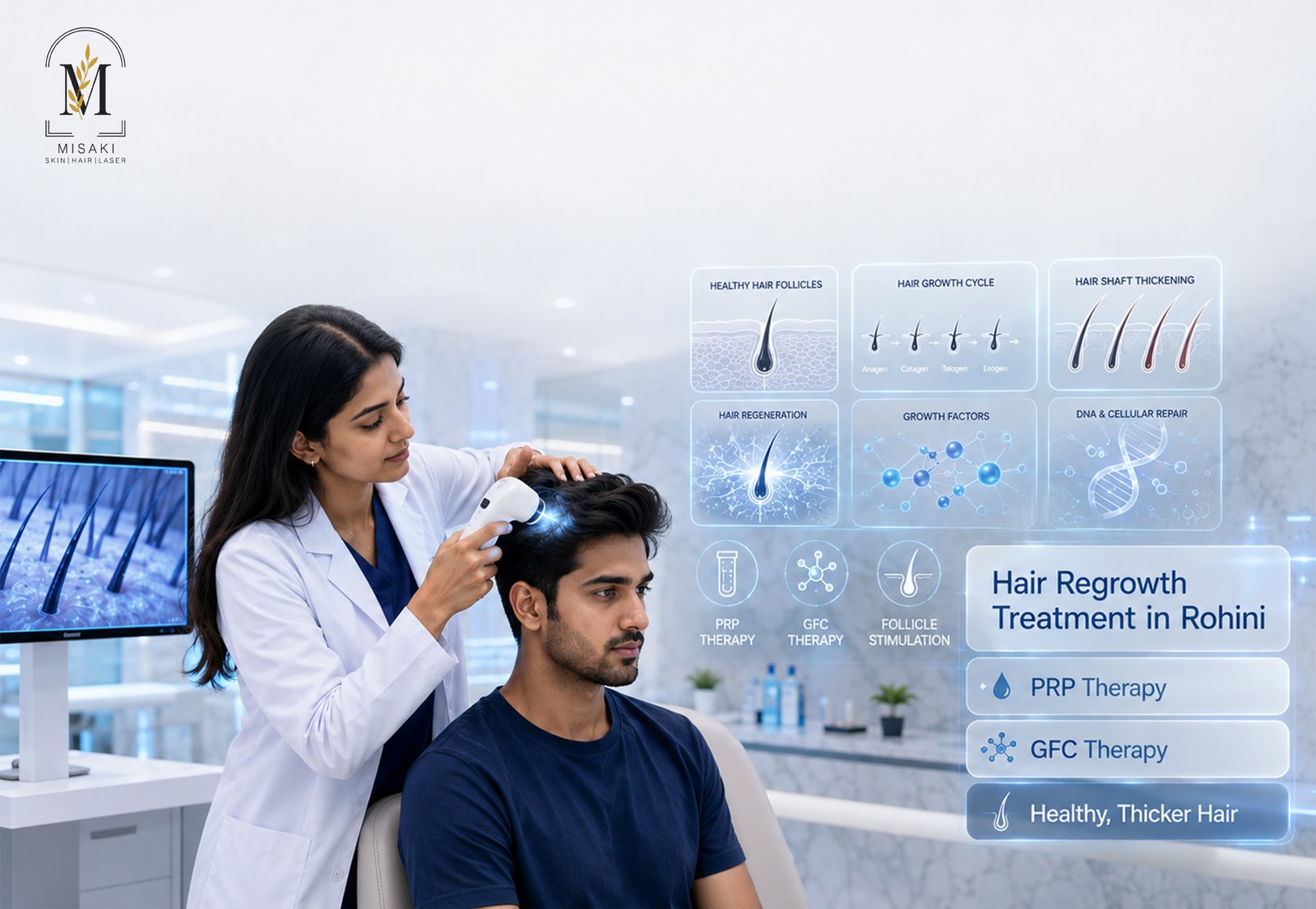
Hair Regrowth Treatment in Rohini: Complete Guide to Restoring Healthy, Thicker Hair
Seeing more strands on your pillow, in the shower drain, or thinning near your temples? You are not alone. Hair fall is one of the most common concerns that a dermatologist sees today, and it can affect confidence just as much as it affects appearance. If you have been searching for a reliable hair regrowth treatment in Rohini, then the good news is that most cases of hair loss are manageable when the root cause is identified early and treated with the right combination of medical care and scalp support.
Hair loss is never treated as a “one size fits all” issue. Before any hair fall treatment in Rohini is recommended, every patient goes through a proper scalp and hair assessment, because hair thinning in a 25-year-old dealing with stress looks very different under the microscope and in treatment planning from age-related thinning in a 45-year-old. In this guide, we’ll discuss the causes of hair loss, how it’s diagnosed, the treatment options (including PRP and GFC therapy), and what a realistic recovery can look like.
Quick Response: Which Hair Regrowth Treatment Is the Best in Rohini?
There is no “best” treatment for all. The right treatment depends on the cause of your hair loss, how far along it is, and the condition of your scalp. Dermatologists usually suggest PRP (Platelet-Rich Plasma) or GFC (Growth Factor Concentrate) therapy, along with a personalized hair care plan, for early to moderate hair thinning. First of all, there is always a proper diagnosis.
Key Takeaways
- There are many causes of hair loss, genetics, hormones, stress, nutrition, and scalp conditions all play a role.
- If it is diagnosed early, the results of the treatment will be better.
- PRP and GFC therapy use the growth factors found naturally in your body to stimulate hair follicle activity.
- Results are progressive; it takes several sessions, not overnight.
- Regular scalp care and maintenance sessions help to preserve the results.
- Before beginning any treatment, you should have an initial consultation with a dermatologist.
What Causes Hair Loss?
Hair loss is seldom due to a single cause. The basis of any successful hair loss treatment in Rohini is what’s driving yours.
Genetics—The most common cause of gradual thinning is androgenetic alopecia, also known as male pattern baldness in men and female pattern hair loss in women. It’s hereditary and usually follows a recognizable pattern — thinning at the temples and crown in men, and diffuse thinning at the part line in women.
Hormonal imbalance—Things like PCOS, thyroid issues, and hormonal changes after having a baby can cause a lot of hair loss. Hormones directly affect the hair growth cycle, and an imbalance can push more follicles into resting or shedding phases.
Stress—Physical or emotional stress such as illness, surgery, or major life events can trigger a temporary but sometimes dramatic shedding phase called "telogen effluvium," typically two to three months after the provoking event.
Nutritional deficiencies—Hair thinning is often linked to deficiencies in iron, vitamin D, zinc, protein, or biotin. Because hair follicles are a metabolically active tissue, they are often the first tissue to show signs of nutritional shortfalls.
Scalp diseases—untreated dandruff, seborrheic dermatitis, fungal infections, or folliculitis—can cause scalp inflammation and interfere with normal follicle function.
Medications and medical conditions—Some medications, including some blood pressure, depression, or chemotherapy medications, and autoimmune illnesses such as alopecia areata can cause hair loss.
Lifestyle factors—poor sleep, too much heat styling, tight hairstyles, harsh chemical treatments and smoking can all accelerate hair thinning over time.
Signs You Need Hair Regrowth Treatment
It's normal to lose 50 to 100 hairs every day. It's time to see a dermatologist if you observe clumps of hair on your pillow, shower drain, or hairbrush, or if you notice excessive hair fall.
- A distinct receding hairline
- Thinning, or loss of hair volume overall
- Widening of the part-line
- Hair loss or bald patches on the head
- Hair that feels thinner, weaker or breaks easier than it used to
If you see any of these, an early assessment for hair regrowth treatment in Rohini can give you an idea of what is happening before the thinning progresses further.
Hair Regrowth Treatments Available
The best dermatologist in Rohini begins every treatment plan with a detailed consultation followed by a scalp assessment to find out the specific cause and severity of hair loss. Only then is a treatment – or a combination of treatments – recommended.
PRP Hair Treatment
Hair Therapy - PRP
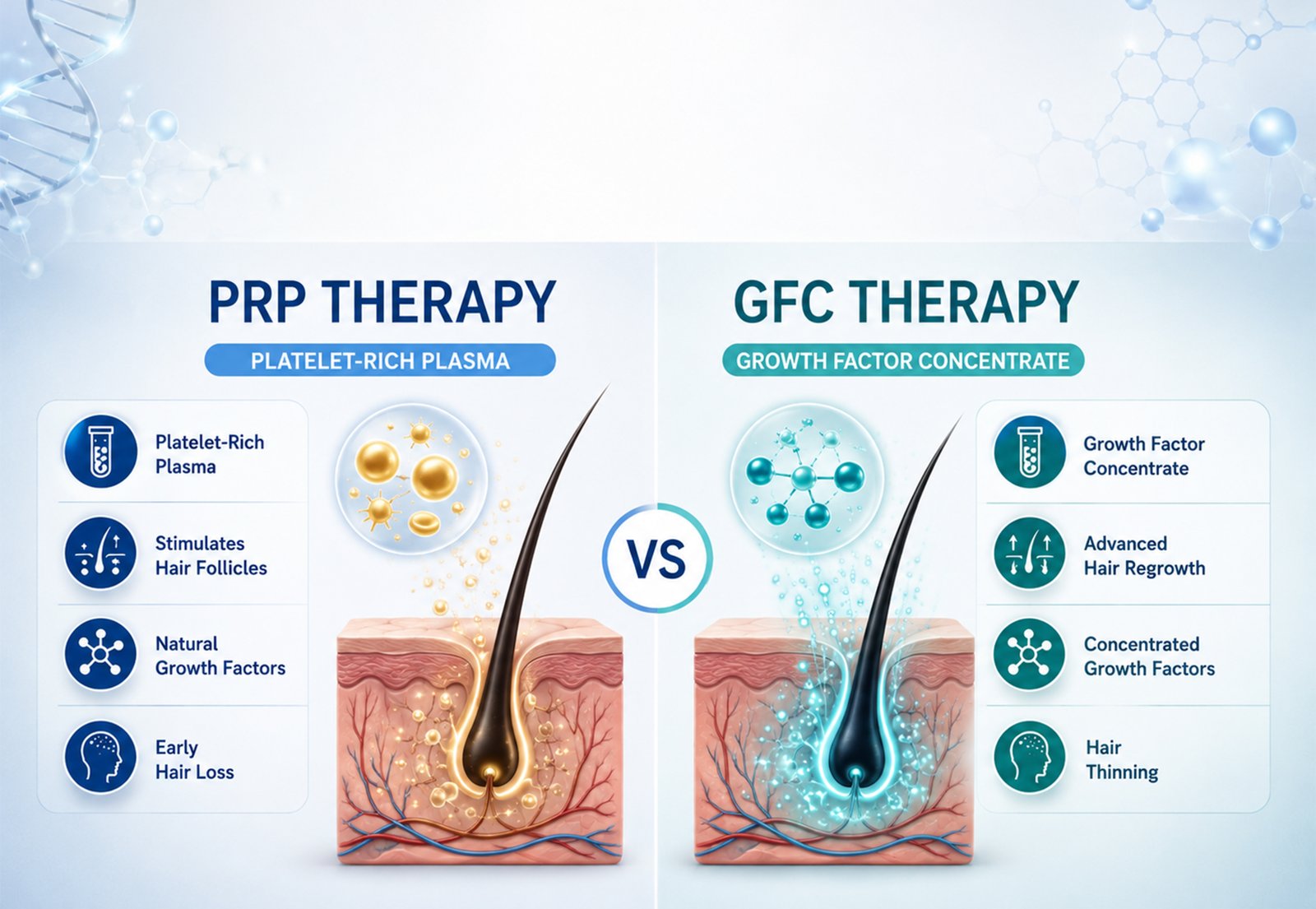
PRP therapy, or Platelet-Rich Plasma therapy, is a procedure in which a small amount of blood is drawn from the patient, processed to concentrate the platelets, and then injected into the scalp as platelet-rich plasma. Platelets contain growth factors that are thought to help to stabilize the hair follicle environment and to activate still-active but weakened follicles.
How it works: Blood is drawn, spun in a centrifuge to isolate the platelet-rich layer, and injected into targeted areas of the scalp using fine needles.
Benefits It is minimally invasive, uses the patient’s own biological material, and usually involves little to no downtime.
Best candidates: PRP seems to work best for early to moderate androgenetic alopecia, when follicles are miniaturized but not yet dormant. Scalp analysis is done to confirm the candidacy for PRP hair treatment in Rohini.
GFC Hair Treatment
GFC (Growth Factor Concentrate) therapy is a more refined and newer evolution of PRP. It filters out a more concentrated set of growth factors from the blood without the red and white blood cells that are present in standard PRP.
Procedure: Similar to PRP in terms of blood draw and injection into the scalp, but the method of processing yields a purer growth factor concentrate.
Growth factors: GFC is believed to provide a more targeted, higher dose of the specific proteins that are involved in hair follicle signaling.
Differences with PRP: GFC involves a more refined preparation process and may be a better option for patients seeking a more concentrated regenerative approach. In the consultation, our dermatologist will check your scalp condition and will suggest which treatment will be better for you—PRP or GFC Hair Treatment in Rohini.
Hair Fall Treatment
For ongoing shedding versus pattern baldness, treatment usually starts with identifying and fixing the underlying trigger.
- Medical Evaluation Blood tests to assess iron levels, thyroid function, vitamin D levels, and other relevant markers.
- Personalized medications: Topical or oral treatments prescribed for the specific diagnosis – not a one-size-fits-all prescription.
- Lifestyle advice: Changes to diet, stress management, and hair care habits that support recovery.
Hair Restoration Treatment
For more established thinning, a hair restoration treatment plan typically combines in-clinic procedures (like PRP or GFC) with supportive home care and periodic scalp reviews to track progress and adjust the plan as needed.
Hair Analysis
Before recommending any treatment, our team will perform a detailed analysis of your hair:
- Scalp check: Look for any inflammation, flaking or infection
- Trichoscopy for assessment of follicle miniaturization and density in different zones of scalp: evaluation of hair density
- Finding the underlying cause Connecting clinical findings with your medical history and lab results
We also train patients in:
- Shampoos and serums recommended by dermatologists for their scalp type
- Scalp care routines to reduce inflammation and buildup
- A straightforward, sustainable home care routine to support treatment in the clinic
Because all plans are tailored to your specific diagnosis, not a standard package, the first consultation is as crucial as the treatment itself.
PRP vs GFC: Which Hair Treatment Is Better?
The best option depends on your dermatologist's evaluation, the condition of your scalp, and the stage of hair loss. Neither treatment is always "better."
| Factor | PRP Therapy | GFC Therapy |
|---|---|---|
| Procedure | Blood drawn, centrifuged, platelet-rich plasma injected into scalp | Blood drawn, processed to isolate a concentrated growth factor serum |
| Growth Factors | Present, along with platelets and some blood cells | More concentrated and purified |
| Session Time | Approx. 45–60 minutes | Approx. 45–60 minutes |
| Downtime | Minimal | Minimal |
| Suitable Candidates | Early to moderate hair thinning | Thinning where a more concentrated approach is preferred |
| Maintenance | Periodic sessions as advised | Periodic sessions as advised |
Hair Regrowth Treatments Comparison
| Treatment | Best For | Downtime | Procedure | Maintenance |
|---|---|---|---|---|
| PRP Therapy | Early hair loss | Minimal | Blood-derived growth factors | Periodic |
| GFC Therapy | Hair thinning | Minimal | Concentrated growth factors | Periodic |
| Medical Hair Treatment | Diffuse hair loss | None | Customized medication/topical plan | Ongoing |
| Hair Transplant | Advanced hair loss | Higher | Surgical follicle relocation | Long-term |
Myth vs Fact
Myth: PRP works after just one session.
Fact: Hair regrowth is gradual. Most dermatologists recommend a series of sessions spaced weeks apart, followed by maintenance visits.
Myth: Hair loss only affects men.
Fact: Female pattern hair loss is common and often shows up as diffuse thinning rather than a receding hairline.
Myth: Hair oils by themselves can grow back lost hair.
Fact: Oils can support scalp health and hair texture, but they don't reverse follicle miniaturization or address hormonal and medical causes of hair loss.
Myth: A hair transplant is the only real solution.
Fact: Transplants are one option for advanced hair loss, but many patients with early to moderate thinning respond well to non-surgical treatments like PRP or GFC combined with medical management.
Myth: Hair thinning is always permanent.
Fact: Many causes of hair fall—nutritional deficiencies, stress-related shedding, and thyroid issues—are reversible once the underlying cause is treated.
What to Expect During Your First Consultation
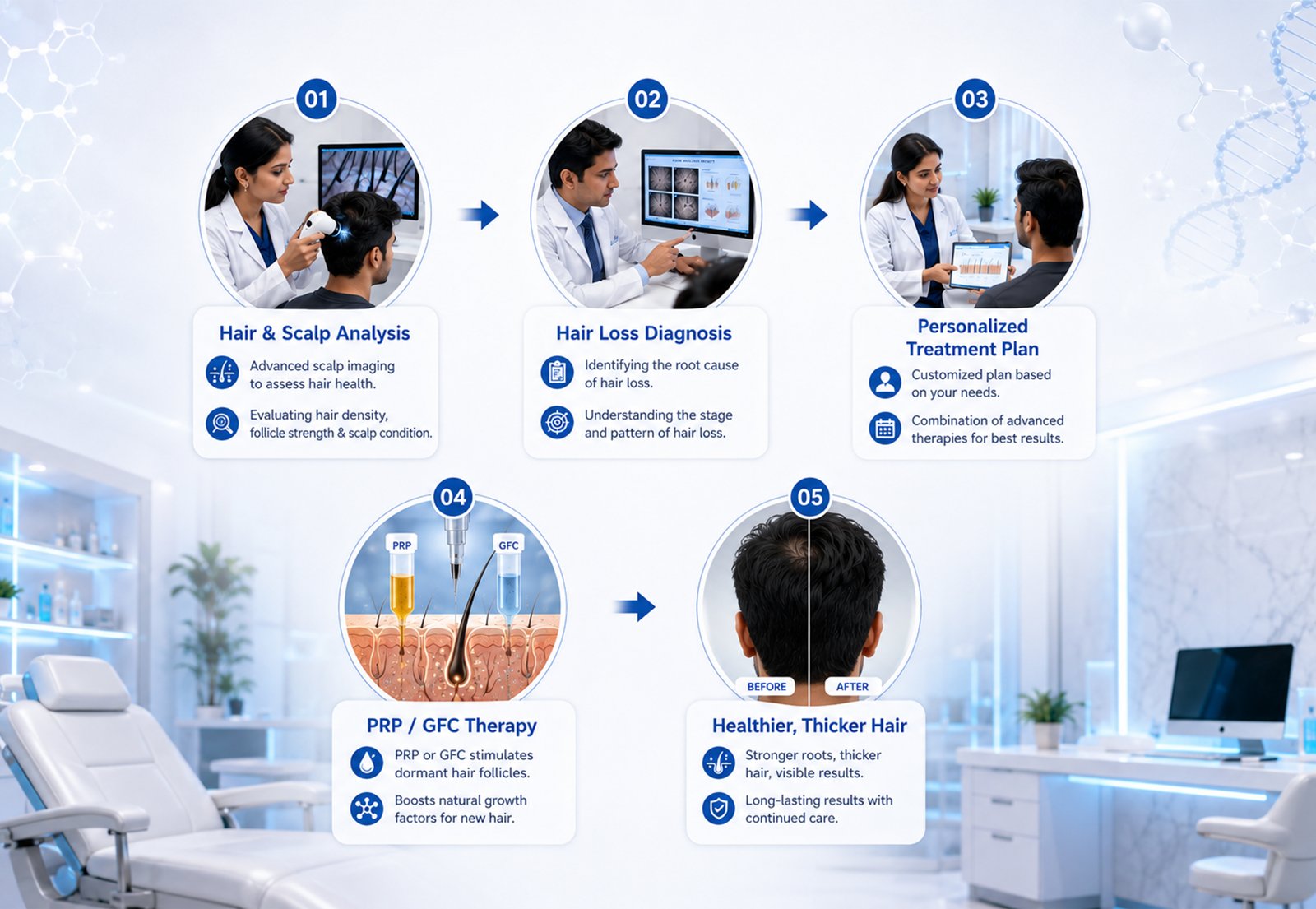
Medical history and hair. The dermatologist will ask you how long you have been losing hair, how much and how often, your family history, your diet, stress levels, and any medications or illnesses.
Scalp check. A visual and trichoscopic exam is done to look for inflammation, scaling, or any signs of infection.
Analysis of hair. Assessment of density and follicles in different zones of the scalp to determine the pattern and stage of hair loss.
Planning treatment. Based on the results and reasonable expectations, your dermatologist will discuss your options. PRP, GFC, medical management, or a mix of these could be among them.
Chronology. Most treatments will need a series of sessions over several months, with periodic maintenance afterwards.
Schedule for follow-up. Plan adjustment is normally reviewed at regular intervals for progress.
Hair Care Tips for Healthy Hair Growth
- Eat a well-rounded diet rich in iron, zinc, biotin and vitamin D – deficiencies in any of these can contribute to shedding.
- Concentrate on protein intake, as hair is primarily made up of keratin, a protein structure.
- Wash your hair regularly to keep your scalp clean and free from buildup that can affect follicle health.
- Adequate sleep, exercise, and relaxation techniques can help you to manage stress, a known trigger for hair loss.
- Follow a mild hair care regimen – Do not wash too much or too less based on your scalp type.
- "Avoid tight hairstyles that pull on the roots, harsh chemical treatments, and overheated styling tools."
Frequently Asked Questions
1. What is Hair Regrowth Treatment?
Hair regrowth treatment refers to a medical or procedural treatment like PRP, GFC therapy, or targeted medication that is meant to support the current hair follicles, and stimulate healthier hair growth once the underlying cause has been properly diagnosed.
2. PRP Hair Treatment: What is it and is it safe?
PRP is when they take a concentrated amount of your own blood that is rich in platelets and growth factors and inject it into the scalp. Because it uses your own blood, it is usually well tolerated, but your dermatologist will check if it is right for you based on your health history.
3. What is GFC hair treatment, and how is it different from PRP?
A more refined version of PRP called GFC (Growth Factor Concentrate) extracts concentrated growth factors devoid of red or white blood cells. Your dermatologist will guide you on which option, PRP or GFC, is better for your scalp condition.
4. How many sessions are required, and are these treatments for both men and women?
Most patients need a series of sessions a few weeks apart, followed by regular maintenance visits, with the number depending on the severity of the problem. PRP or GFC therapy can be offered to both men and women after a proper evaluation.
5. What causes hair loss, and is it permanent?
Genetics, hormonal changes, stress, nutritional deficiencies, and scalp conditions are common causes. Reversible Hair Loss – Many types of hair loss, especially those caused by stress, diet or thyroid problems, are reversible once the underlying cause is addressed.
6. Does treatment hurt, and what should I stay away from afterwards?
The injections are minimally uncomfortable (like a prick on the scalp) and are well tolerated by most patients. The aftercare usually includes avoiding hair washing, harsh chemical treatments, and sun exposure for a short period of time, as instructed by your dermatologist.
7. Do I need to have a consultation, and how do I make an appointment?
Yes, it is important to have a proper scalp assessment and diagnosis before beginning any hair regrowth treatment, as each individual requires a different approach. You can either book a consultation with us through our website or directly contact our Rohini clinic.
Final Thoughts
Hair loss can be devastating. But it’s rarely something you have to deal with without choices. The first step in moving forward is finding the correct diagnosis—not a guess—on whether your thinning is due to genetics, hormones, stress, or scalp health. Understanding the underlying cause of your hair loss and creating a plan based on your goals, lifestyle, and scalp are the first steps in our hair regrowth treatment in Rohini at Misaki Skin Clinic. To create a treatment plan, we combine supporting medical care with evidence-based options like PRP and GFC therapy.
If persistent hair fall, thinning, or a receding hairline has been a thought in your mind, the most useful next step is a proper scalp assessment.
Book an appointment at Misaki Skin Clinic to get a personalized assessment of the health of your hair and scalp and a treatment regimen tailored to the actual needs of your hair.
Take the Next Step
Book a consultation with Misaki Skin Clinic today for a personalized assessment of your skin and expert advice on treatment options.
📍 D-12/183, 1st Floor, Sai Baba Chowk, Sector-8, Rohini, Delhi - 110085
📞 Call or WhatsApp: +91-9292920808
🕒 Open Monday–Sunday, 10:30 AM – 7:30 PM
This article is for informational purposes and is not medical advice. Consult a licensed dermatologist for diagnosis and treatment tailored to your condition.