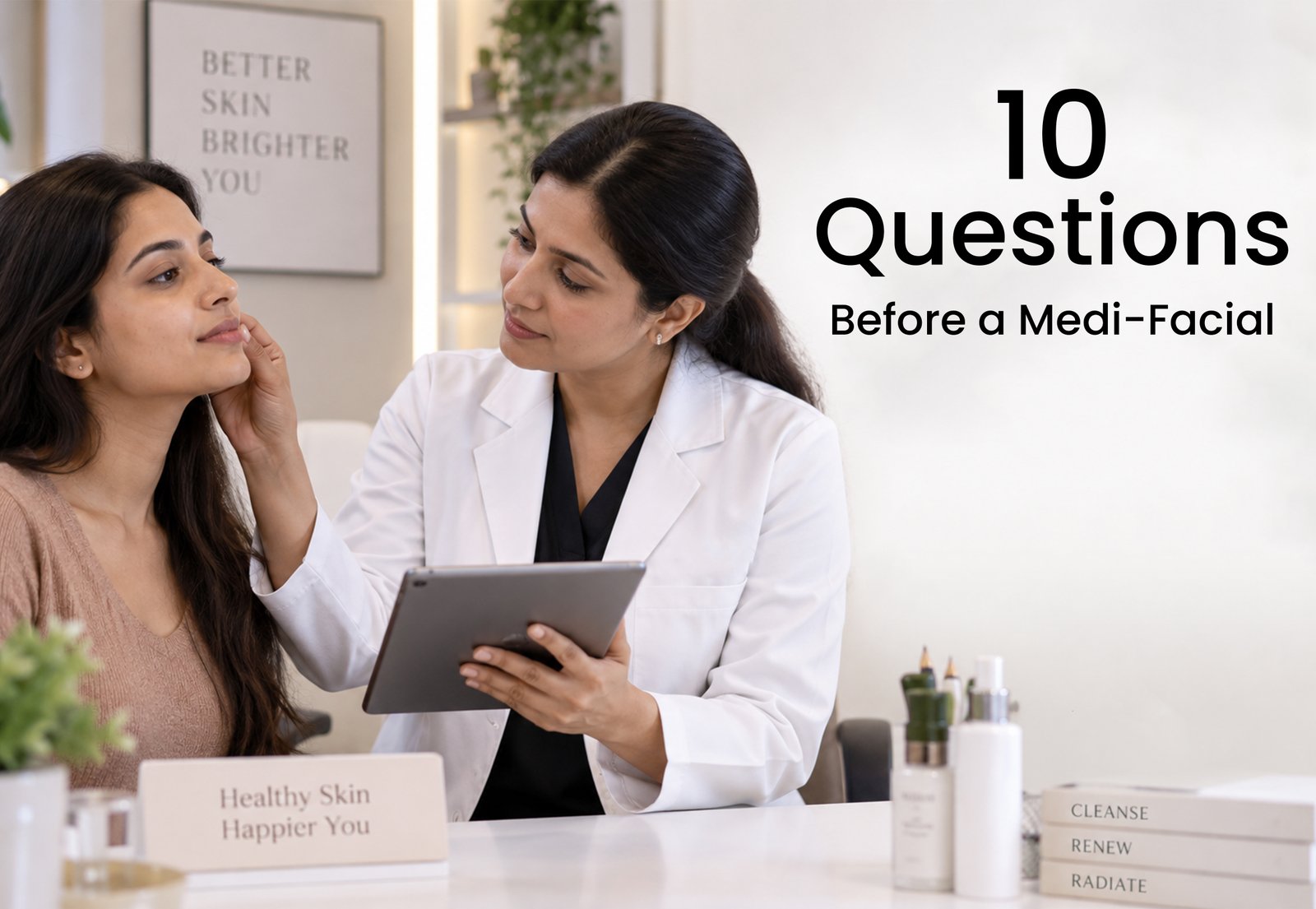
It is important to do your research before booking a Medi-Facial in Rohini. It has become almost trendy to use the term “Medi-Facial” to increase the perceived value of a regular salon facial. Some clinics may use aesthetic devices during the treatment. However, “Medi-Facial” is a highly unregulated term and the treatment may vary drastically from clinic to clinic. A treatment should be personalized to your skin needs and your clinical history. You should not choose a treatment solely based on its position in a treatment menu. Here, I have included a few important questions to ask before making a booking.
What Is a Medi-Facial?
"Medi-facial" is a term used to describe a clinical facial. A clinical facial will consist of a skin assessment to determine the needs of your skin. A medi-facial will also consist of cleansing and exfoliating your skin, followed by nourishing your skin with various products, and may also include the use of medical or aesthetic devices. Each treatment is customizable to each individual to ensure the best results.
It is important to understand that the term "medifacial" is used to describe a general idea of a treatment. Aestheticians may use varying products and devices and overall differing treatment philosophies to achieve similar results.
Medi-Facial vs Regular Facial: What's the Difference?
| Feature | Regular Facial | Medi-Facial |
|---|---|---|
| Main focus | General skincare/relaxation | Targeted skin concerns |
| Skin assessment | May be limited | May involve professional assessment |
| Ingredients | Cosmetic skincare | Professional/active formulations depending on protocol |
| Devices | May be limited | May incorporate aesthetic devices depending on treatment |
| Customization | Varies | Often tailored to skin concerns |
| Medical oversight | Depends on provider | Depends on clinic and treatment protocol |
The exact approach varies considerably between clinics — this table reflects general tendencies, not a guarantee of what any specific provider offers.
10 Questions to Ask Before Getting a Medi-Facial
1. Who Will Be Performing My Medi-Facial and What Are Their Credentials?
It's reasonable to ask who's actually performing the treatment, their relevant qualifications, their experience with this specific procedure, and whether medical supervision is involved where the protocol calls for it. This isn't about assuming something is wrong — it's a normal question for any skin treatment, and a clinic confident in its staffing shouldn't hesitate to answer clearly.
2. How Does a Medi-Facial Differ From a Standard Facial?
Ask specifically what makes this particular Medi-Facial different from a regular facial at your usual salon — professional active ingredients, a more structured treatment protocol, skin-focused customization, or aesthetic devices, for instance. It's worth noting that a Medi-Facial isn't automatically medically superior to every conventional facial; the value depends on whether the specific protocol actually addresses your concern.
3. What Skin Concern Is This Medi-Facial Designed to Treat?
Treatment selection often depends on the specific concern involved — dullness, dehydration, uneven skin tone, mild pigmentation concerns, acne-prone skin, congested pores, texture issues, or general skin rejuvenation. Medi-Facial for acne and Medi-Facial for pigmentation are genuinely different treatments in practice, even if both get grouped under the same broad term, so it's worth confirming which concern the specific protocol you're being offered is actually designed around.
4. What Ingredients, Serums, Peels or Products Will Be Used?
It's entirely reasonable to ask exactly what's being applied to your skin — active ingredients, exfoliating agents, hydrating components, serums, or professional peels where relevant. This matters particularly if you have known sensitivities or allergies. A provider should be able to name what's in the treatment, not just describe it in vague terms like "specialized formula."
5. Am I a Good Candidate for This Medi-Facial?
Suitability can depend on your skin type, sensitivity level, whether acne is currently active, existing pigmentation, your skin barrier's current condition, your existing skincare routine, any recent cosmetic procedures, broader medical history, and current medications where relevant. If a provider skips this question entirely and moves straight to treatment, that's worth noticing.
6. Do I Need to Prepare My Skin Before the Treatment?
Ask whether you need to modify your routine beforehand — some protocols call for pausing certain active ingredients like retinoids, AHAs, BHAs, or strong exfoliants in the days leading up to treatment, since these can increase sensitivity. This is a legitimate question to raise, though any advice involving prescribed medications should come from your prescribing doctor, not the facial provider.
7. What Downtime or Side Effects Should I Expect?
Depending on the specific protocol, possible short-term effects can include mild redness, temporary sensitivity, tightness, mild peeling, or temporary dryness. Downtime genuinely varies by treatment type — a claim that any Medi-Facial has zero downtime under all circumstances is worth treating with some skepticism rather than taking at face value.
8. What Aftercare Will I Need?
Following the provider's specific instructions matters more than generic skincare advice. This typically includes gentle skincare, appropriate moisturization, sun protection, avoiding unnecessary irritation, and understanding roughly when any normal post-treatment effects should improve. Aftercare requirements vary by procedure, so ask what applies specifically to what you just had done.
9. How Many Medi-Facial Sessions Will I Need?
It helps to understand whether you're looking at a one-time facial for temporary refreshment, a planned series of treatments, or an ongoing maintenance schedule. Session frequency depends on your specific skin concerns, the treatment type, how your skin responds, and your goals. No provider can honestly promise a specific number of sessions that applies to every person walking through the door.
10. What Results Can I Realistically Expect From a Medi-Facial?
Realistic outcomes for many Medi-Facials include a temporary glow, improved hydration, smoother-feeling skin, a fresher appearance, and mild improvement in certain surface-level concerns. It's worth being direct: a Medi-Facial should not be presented as a guaranteed cure for a significant dermatological condition — that's a different category of treatment altogether.
What Can a Medi-Facial Treat?
Medi-Facials can address a variety of skin conditions. These conditions can include: dullness, dehydration, irregular skin tone, mild pigmentation, skin congestion, rare cases of acne, skin texture, skin rejuvenation, and more. Different skin conditions can overlap. It is always best to speak with an expert to determine your eligibility for a Medi-Facial.
When Is It Necessary to See a Dermatologist Before Receiving a Medi-Facial?
Certain conditions do require a visit to a dermatologist prior to receiving a Medi-Facial. These conditions include, but are not limited to, acne, pigmentation, skin infections, skin irritations, rashes, persistent redness, and inflammatory skin conditions. It is best to rule out these conditions before receiving any facial treatment. A dermatologist in Rohini can assess your skin to see if you are a good candidate for a Medi-Facial and if there are no medical concerns.
Medi-Facial in Rohini: How to Choose the Right Clinic
A practical checklist worth using:
- Qualified and experienced professionals performing the treatment
- Proper skin assessment before any procedure begins
- A customized treatment protocol rather than a fixed package
- Clear explanation of the ingredients and procedures involved
- Transparent discussion of possible side effects
- Proper hygiene and safety practices
- Appropriate aftercare guidance provided in writing or verbally
- Realistic expectations set upfront, not oversold
- Follow-up availability if needed
- No guaranteed-result claims
When comparing your options for the best skin clinic in Rohini, this checklist is a more reliable filter than marketing language alone.
Medi-Facial Services at Misaki Skin & Laser Clinic
Misaki Skin & Laser Clinic offers several relevant skin services, including:
- HydraFacial for hydration, exfoliation, and general skin maintenance
- Skin Rejuvenation treatments for broader texture and radiance concerns
- Chemical Peel and Carbon Laser Peel options for tone and texture
- Acne Treatment for active breakouts
- Pigmentation Treatment, including peels formulated specifically for uneven tone
- Q-Switched Laser for pigmentation and marks
- Anti-Aging Treatments for texture and firmness concerns
- Personalized skincare and treatment plans following consultation
Not every service listed here is technically a Medi-Facial — they're mentioned because they're part of what the clinic offers for related skin concerns that often come up in the same consultation. Treatment selection depends on your individual skin concerns and a professional evaluation, not a fixed menu applied to everyone.
Medi-Facial Aftercare Tips
- Generally, your aftercare instructions are individualized based on the treatment you have received. Therefore, information provided by your health care practitioner takes precedence over any information available on the internet.
- Try using only gentle and non-abrasive products on your skin for the first few days after your treatment.
- Always apply adequate sun protection, preferably of at least SPF 30, on days you anticipate your skin will be exposed to the sun.
- Avoid enthusiastic exfoliation for the first week after your treatment.
- Avoid picking at your skin.
- Use your health care practitioner’s recommended products and follow the recommended frequency of use.
- Report to your health care practitioner if you think you are experiencing an adverse reaction to your treatment.
Frequently Asked Questions
What makes a Medi-Facial different from a traditional facial?
A clinical approach is taken for the assessment of skin conditions during a Medi-Facial. Aesthetic devices may also be incorporated into the treatment. A focus on general relaxation and maintenance of skin condition is the goal of a traditional facial.
Can a medi-facial assist with acne?
A medi-facial may assist with superficial acne-related conditions such as open comedones (blackheads) and excessive skin oiliness. True acne requires further assessment and a more comprehensive management plan.
Is a medi-facial appropriate to help with skin pigmentation?
Certain medi-facial treatment plans may help with superficial skin pigmentation. Other more effective treatment plans are available to manage skin pigmentation.
Are there adverse effects and downtime with a Medi-Facial?
The amount of downtime associated with a particular protocol will vary. Some protocols may cause your skin to be temporarily sensitive and/or dry and peeling. If you have not already received a consultation for the protocols that interest you, it is appropriate to ask about expected side effects and downtime.
How many treatments are necessary?
This will vary depending upon the concern that you are addressing. Some patients receive periodic maintenance treatments.
How should I prepare?
Usually, you will not be allowed to use any active products (i.e. Retin-A, glycolic acid, salicylic acid, etc.) for a period of time before your treatment. Follow your provider's instructions closely. General pre-treatment instructions may vary.
Where can I get a Medi-Facial?
There are a number of facilities in Rohini that offer Medi-Facials. Take the time to research and compare the quality and transparency of the consultations.
Take the Next Step
D-12/183, 1st Floor, Sai Baba Chowk, Sector 8, Rohini, Delhi - 110085 — Near Rohini East Metro Station
Call or WhatsApp: +91-9292920808
Open Monday–Sunday, 10:30 AM – 7:30 PM
→ Explore HydraFacial and Medi-Facial options
→ Get in touch or book an appointment
This article will not provide you with medical advice. To understand the condition that you are experiencing, as well as the best ways to treat it, you should contact a dermatologist.